


Understanding Communal Living Properties in Alberta: A Practical Guide for Owners and Investors
As Calgary continues to densify and evolve, communal living arrangements are becoming increasingly common. From high-rise condominiums to cooperative housing and community-driven neighbourhood associations, these ownership and governance structures play a critical role in how properties are operated, maintained, and valued.
At Citysearch, we work across a broad spectrum of residential assets—from investor-owned condominiums to large-scale communities—and one consistent theme emerges: not all communal living structures are created equal. Understanding the differences is essential for owners, boards, and residents alike.
This article breaks down the three primary forms of communal living properties in Alberta—condominiums, cooperatives, and community associations—and provides practical insight into how each operates.
Condominiums: Individual Ownership with Shared Responsibility
Condominiums are the most widely recognized form of communal living in Alberta and are governed by the Condominium Property Act.
In a condominium structure, ownership is divided into two parts:
- Private ownership of a unit, and
- Shared ownership of common property, held collectively with other owners
Common property includes elements such as hallways, elevators, building exteriors, mechanical systems, and shared amenities like gyms or parkades.
Key Characteristics of Condominiums:
- Owners hold title to their individual unit
- Common areas are jointly owned as tenants in common
- A condominium corporation is automatically formed upon registration
- Monthly condo fees fund operations, maintenance, and reserve planning
The condominium corporation is responsible for maintaining and managing the shared components of the property. This includes everything from snow removal and landscaping to major capital projects such as roof replacements or parkade rehabilitation.
Governance Structure
Each condominium is governed by an elected board of directors, typically composed of unit owners. The board is responsible for:
- Budgeting and financial oversight
- Enforcing bylaws and rules
- Managing vendors and service contracts
- Planning for long-term capital expenditures
At Citysearch, we often describe condominiums as “mini municipalities”—they require structured governance, financial discipline, and operational expertise to function effectively.
Cooperatives: Collective Ownership and Shared Decision-Making
Cooperative housing represents a fundamentally different approach. Rather than owning real property, individuals own shares in a corporation that owns the building.
These structures are governed by the Cooperatives Act.
Key Characteristics of Cooperatives:
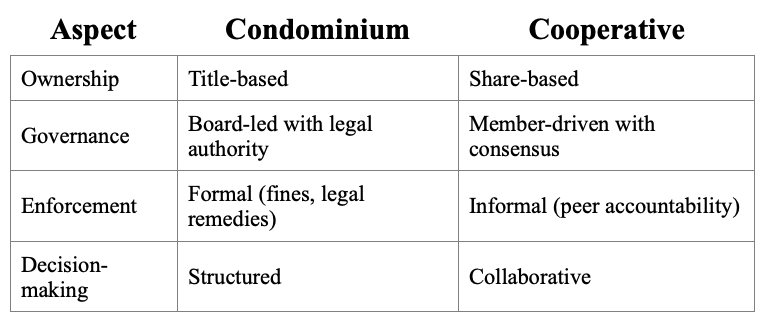
- Ownership is share-based, not title-based
- Members do not own their unit directly
- The cooperative corporation owns the entire property
- Members occupy units through occupancy agreements or leases
This model places a strong emphasis on collective responsibility and participation. Members are not just occupants—they are stakeholders in the entire property.
Governance Structure
Cooperatives are typically governed by a board elected from among the members. However, compared to condominiums, governance tends to be:
- More participatory
- Less formal in enforcement
- More reliant on consensus and collaboration
Decision-making often involves broader member input, and there is generally a stronger sense of community involvement.
From a management perspective, cooperatives can function well when there is alignment among members—but they can also face challenges when consensus is difficult to achieve.
Community Associations: Supporting Neighbourhood Living
Community associations are different again. These are typically non-profit organizations that exist to support a defined geographic area rather than manage residential units directly.
They are not governed by a specific real estate statute like condominiums or cooperatives but are structured under general corporate or non-profit frameworks.
Key Characteristics of Community Associations:
- Focus on shared amenities (parks, community halls, recreational facilities)
- Membership may be voluntary or tied to property ownership
- Funded through fees, donations, or municipal support
- Emphasis on community engagement and programming
These organizations are often the backbone of neighbourhood identity—organizing events, maintaining shared spaces, and fostering a sense of belonging.
Governance Structure
Like condominiums and cooperatives, community associations are governed by a board of directors. Their responsibilities typically include:
- Managing budgets and funding
- Maintaining shared facilities
- Coordinating events and programming
While less operationally complex than a condominium, effective governance is still essential.
Choosing the Right Structure: Practical Considerations
Selecting the right type of communal living arrangement depends on the goals and preferences of the individual or group involved.
Scenario-Based Insights
1. Urban Buyer Seeking Convenience
A professional or family looking for a low-maintenance lifestyle with access to amenities would likely be best suited to a condominium. The ability to outsource maintenance while enjoying shared facilities is a key advantage.
2. Community-Oriented Ownership Group
A group of individuals who value collaboration and shared decision-making may find a cooperative model appealing. This structure supports equal participation but requires alignment among members.
3. Neighbourhood Engagement
Residents looking to enhance their local area—through parks, events, or shared initiatives—would benefit from involvement in a community association.
At Citysearch, we often guide clients through these considerations, ensuring alignment between their objectives and the structure they choose.
Governance Matters: Where Things Succeed or Fail
One of the most critical distinctions between these property types lies in how they are governed.
Condominium Governance
Condominiums operate within a structured legal framework. Bylaws are mandatory and enforceable, addressing:
- Board responsibilities
- Owner obligations
- Use of common property
- Voting procedures
Importantly, condominium corporations have the authority to enforce compliance, including issuing fines or sanctions where necessary.
This structure provides clarity and accountability—but it also requires discipline and consistency.
Cooperative Governance
In contrast, cooperatives rely more heavily on member engagement and shared responsibility. While bylaws exist, enforcement is typically less rigid.
This can create a more collaborative environment, but it can also introduce ambiguity if expectations are not clearly defined.
Key Differences in Practice
The Citysearch Perspective: Why Structure Matters
From a property management standpoint, the ownership structure directly impacts:
- Risk exposure
- Operational complexity
- Financial planning
- Long-term asset performance
Condominiums, in particular, require a high level of sophistication. Poor governance, inadequate reserve funding, or reactive maintenance can significantly impact property values.
At Citysearch, we approach condominium management with a systems-driven, proactive mindset:
- Strategic budgeting and reserve planning
- Strong governance support for boards
- Vendor management and cost control
- Transparent financial reporting
We believe that well-managed properties not only preserve value—they enhance it.
Final Thoughts
Communal living is not just about shared space—it is about shared responsibility, governance, and long-term planning.
Whether it is a condominium tower in Calgary’s core, a cooperative housing model, or a neighbourhood association, each structure requires a clear understanding of:
- Ownership rights
- Governance obligations
- Financial commitments
The legislation—whether the Condominium Property Act or the Cooperatives Act—provides the framework. But execution is what ultimately determines success.
At Citysearch, we specialize in bridging that gap—turning governance into performance and properties into well-run communities.
Because in our view, quality management is not a cost—it is the foundation of value.